 Tapnod
The short answer
AI agent observability tools fall into four groups:
| Group | Examples | Best for |
|---|---|---|
| Open-source LLM platforms | Langfuse, Arize Phoenix, Comet Opik | Traces and evals, self-hosting option |
| Hosted LLM platforms | LangSmith, Braintrust, AgentOps | Fast setup, framework integrations, evals |
| General observability | Datadog LLM Observability, Grafana with OpenTelemetry | Teams with existing monitoring |
| Operational agent views | Agent inboxes with monitoring | Last contact, waiting decisions, results |
Pick a trace platform by your framework, budget model and hosting needs. Add an operational view if your agents run unattended. Most teams need one of each, not five tools.
"ai agent observability tools" gets about 170 US searches a month at a keyword difficulty of 47, with a cost per click around $30, and "best ai agent observability tools" adds 40 (Semrush, November 2026). The high CPC tells you vendors compete hard for this term, so independent comparisons are worth more than vendor lists.
Langfuse
Open-source LLM engineering platform covering tracing, evaluations, prompt management and metrics. ClickHouse acquired Langfuse in January 2026; Langfuse says it remains open source and self-hostable, with Langfuse Cloud continuing.
- Strengths: open source core under MIT, self-hosting, OpenTelemetry support, broad integrations.
- Pricing: Hobby free with 50k units a month; Core $29 a month with 100k units; Pro $199; self-hosting free. Units count traces, observations and scores.
- Consider if: you want open source, or to self-host.
LangSmith
LangChain's platform for observability, evaluation and deployment. Works with any framework, with the deepest integration for LangChain and LangGraph.
- Strengths: LangGraph tooling, evaluation workflows, Agent Inbox and Studio around it.
- Pricing: Developer free for one seat with 5k base traces a month; Plus $39 per seat a month with 10k base traces; Enterprise custom. Self-hosting is Enterprise-only.
- Consider if: you build on LangChain or LangGraph.
Arize Phoenix
Open-source observability and evaluation, built on OpenTelemetry, with Arize's commercial platform above it.
- Strengths: OpenTelemetry-native, strong evaluation tooling, local use.
- Consider if: you want open standards and evals with a path to an enterprise platform.
AgentOps
Agent-focused observability with session replays, cost tracking and multi-agent views, through a Python SDK with many framework integrations. The app is open source and can be self-hosted; a hosted version has a free tier.
- Strengths: session-centred view, replays, quick setup.
- Consider if: you want agent-first debugging across frameworks. See AgentOps review.
Braintrust
Evaluation-first platform with logging and tracing, popular with teams that treat evals as part of development.
- Consider if: evaluation and experiments are your main need.
Comet Opik
Open-source tracing, evaluation and agent testing, with a hosted free tier and paid plans.
- Consider if: you want open source with a low-cost hosted option.
Datadog and Grafana
General observability platforms that accept LLM and agent data. Datadog has a dedicated LLM Observability product; Grafana works with OpenTelemetry traces in Tempo and metrics in Prometheus or Mimir.
- Consider if: your on-call already lives there, and you want agents next to everything else.
Operational views
Trace platforms show runs that sent data. For unattended agents you also need: which agents are alive, which went silent, and what's waiting on a person. Agent inboxes with monitoring cover that, alongside questions, approvals, results and errors. Most teams pair one with a trace platform.
Comparison table
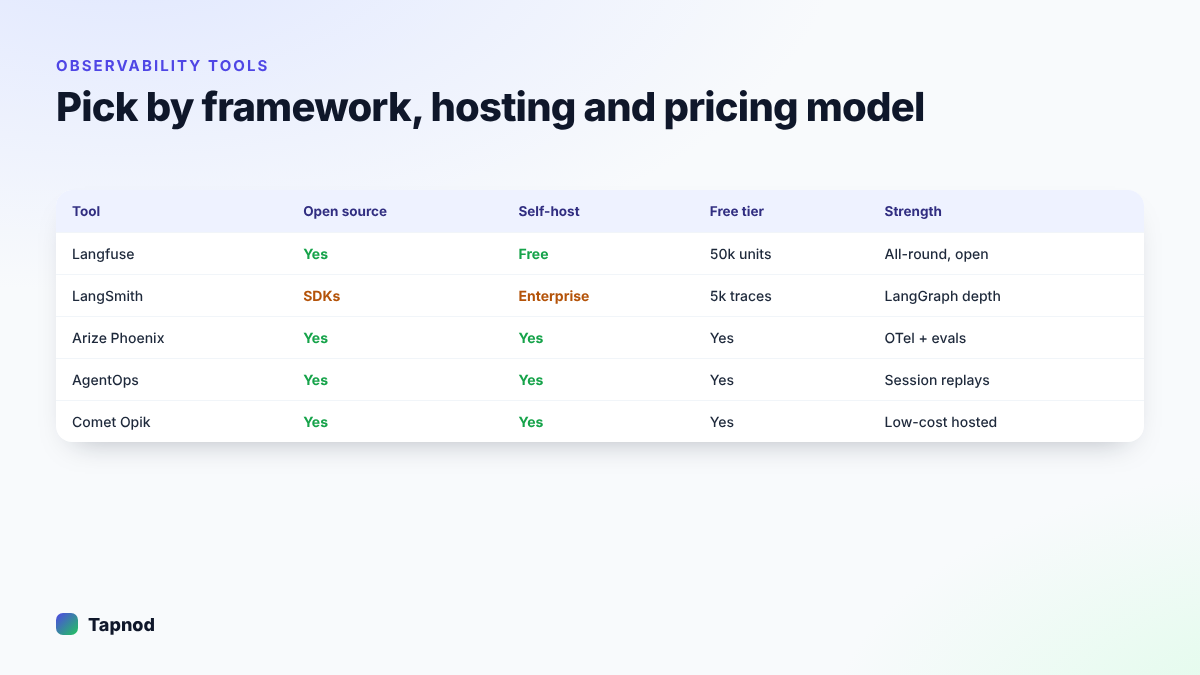
| Tool | Open source | Self-host | Free tier | Pricing model | Strength |
|---|---|---|---|---|---|
| Langfuse | Yes (core) | Yes | 50k units | Units + plan | Open, all-round |
| LangSmith | No (SDKs open) | Enterprise | 5k traces | Seats + traces | LangGraph depth |
| Arize Phoenix | Yes | Yes | Yes | Platform tiers | OTel and evals |
| AgentOps | Yes (app) | Yes | Yes | Events + plan | Session replays |
| Braintrust | No | Ask vendor | Yes | Usage + plan | Evals |
| Comet Opik | Yes | Yes | Yes | Spans + plan | Open, low cost |
| Datadog LLM Obs | No | No | Trial | Usage | Existing monitoring |
Pricing changes often; check each vendor's page before deciding.
How to choose
- Framework: LangChain or LangGraph users get the most from LangSmith; others can choose freely.
- Hosting: if data must stay in your network, shortlist Langfuse, Phoenix, Opik or AgentOps self-hosted.
- Budget model: seat-based pricing suits small teams with many traces; usage-based suits large teams with moderate volume.
- Evals: if evaluation is central, weigh Braintrust, LangSmith and Phoenix.
- On-call: if your team already uses Datadog or Grafana, consider sending agent data there.
- Unattended agents: add an operational view for silence and waiting decisions.
Pricing models explained
Vendors meter different things, which makes headline prices hard to compare:
| Meter | Counts | Watch for |
|---|---|---|
| Seats | People with access | Costs grow with team size, not usage |
| Traces | Top-level runs | Long agent runs count once, short chats count often |
| Units or spans | Every step inside a trace | Agents with many tool calls use far more |
| Events | SDK-recorded events | Varies by how the SDK records steps |
| Retention | How long data is kept | Upgrades can be triggered by features like online evals |
Estimate with a real week of traffic. An agent that makes 40 tool calls per run looks cheap on a per-trace plan and expensive on a per-span plan; a chat assistant is the reverse.
Running a fair trial
- Instrument one real agent, not a demo.
- Send the same week of traffic to two tools if you can.
- Measure: setup time, how fast you find the cause of a real failure, monthly cost at your volume, and how teammates react.
- Test export: make sure you can get your data out.
Features that matter more than they look
- Search and filters by agent, version, user and outcome: daily use depends on these.
- Linking to business objects like ticket or order IDs, so non-engineers can find runs.
- Alerts that reach a person, not only dashboards.
- Data export in open formats, so leaving is possible.
- Access control, since traces often hold customer content.
What OpenTelemetry changes
Most platforms accept OpenTelemetry traces now. If you instrument with OpenTelemetry and its GenAI conventions, switching vendors becomes a configuration change. The conventions are still in development, but they're stable enough that most new instrumentation uses them.
A worked example
Picture a 12-person team with LangGraph agents, two coding agents and an n8n workflow. They trial LangSmith and Langfuse for two weeks. LangSmith's LangGraph views win for debugging; Langfuse's unit pricing wins on cost at their volume. They pick Langfuse self-hosted for traces, keep LangGraph Studio for local debugging, and use an agent inbox for operational monitoring and approvals across all agents.
Key takeaways
- Four groups: open-source LLM platforms, hosted LLM platforms, general observability and operational views.
- Choose by framework, hosting, pricing model and evaluation needs.
- Instrument with OpenTelemetry to stay portable.
- Pair a trace platform with an operational view for unattended agents.
FAQ
What are the best AI agent observability tools?
Commonly used options include Langfuse, LangSmith, Arize Phoenix, AgentOps, Braintrust, Comet Opik and Datadog LLM Observability. The best fit depends on your framework, hosting and budget.
Which agent observability tools are open source?
Langfuse, Arize Phoenix, Comet Opik and the AgentOps app have open-source versions you can self-host.
Is LangSmith only for LangChain?
No. It works with other frameworks, but its deepest features are for LangChain and LangGraph.
Do I need more than a trace platform?
For unattended agents, yes: add monitoring for last contact, silent agents and decisions waiting on people.
Where Tapnod fits
Tapnod is the operational view: active agents, last contact and waiting decisions next to every agent's questions, results and errors. Start free.