 Tapnod
The short answer
LangSmith is LangChain's platform for tracing, evaluating and deploying agents. It's at its best with LangChain and LangGraph. Teams look for alternatives mostly for three reasons: pricing at scale (seats plus traces), self-hosting (Enterprise-only), or framework fit when they don't use LangChain.
| Need | Alternative |
|---|---|
| Open source and free self-hosting | Langfuse, Arize Phoenix, Comet Opik |
| Unit pricing without seat fees | Langfuse |
| OpenTelemetry-first with evals | Arize Phoenix |
| Agent session replays | AgentOps |
| Evaluation-driven workflow | Braintrust |
| Same place as existing monitoring | Datadog LLM Observability, Grafana |
"langsmith alternative" gets about 30 US searches a month (Semrush, November 2026). Small, but most of it comes from teams already paying for LangSmith and reviewing the bill or the hosting model.
LangSmith at a glance
| Plans | Developer free (1 seat, 5k base traces a month); Plus $39 per seat a month (10k base traces); Enterprise custom |
| Billing | Seats, plus traces beyond the allowance, plus extended retention |
| Self-hosting | Enterprise only |
| Strengths | LangGraph Studio, evaluations, Agent Inbox, deployment |
| Framework | Any, deepest for LangChain and LangGraph |
Langfuse
Open-source platform with traces, evaluations and prompt management. Acquired by ClickHouse in January 2026; it says it stays open source and self-hostable.
- Why switch: no seat fees on cloud plans, free self-hosting, OpenTelemetry support.
- Pricing: Hobby free (50k units); Core $29 a month (100k units, unlimited users); Pro $199 a month.
- Watch for: fewer LangGraph-specific views than LangSmith.
Arize Phoenix
Open-source, OpenTelemetry-based observability and evaluation.
- Why switch: open standards, strong evals, local and self-hosted use, and a clear path to a managed platform if you grow.
- Watch for: enterprise features in Arize's commercial platform.
Comet Opik
Open-source tracing and evaluation with a low-cost hosted plan.
- Why switch: open source with an inexpensive managed option.
AgentOps
Agent-focused observability with session replays and cost tracking; the app is open source.
- Why switch: replays and a session-centred view across frameworks.
Braintrust
Evaluation-first platform with tracing.
- Why switch: if evals and experiments are your main workflow and you want them closely tied to your development process.
Datadog and Grafana
- Why switch: keep agent telemetry next to the rest of your systems and on-call.
Comparison
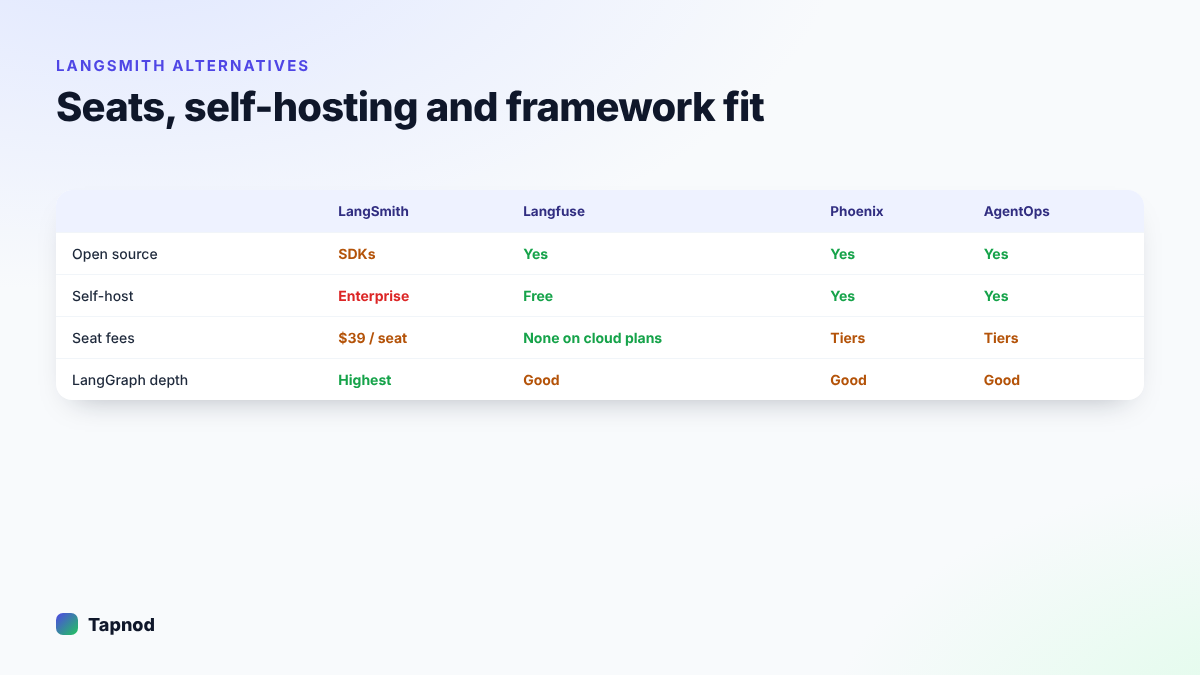
A quick view of how the main options line up on the points teams ask about most.
| LangSmith | Langfuse | Phoenix | Opik | AgentOps | |
|---|---|---|---|---|---|
| Open source | SDKs | Yes | Yes | Yes | Yes |
| Self-host | Enterprise | Free | Yes | Yes | Yes |
| Seat fees | Yes | No (cloud plans) | Tiers | Tiers | Tiers |
| LangGraph depth | Highest | Good | Good | Good | Good |
| Evals | Strong | Strong | Strong | Strong | Basic |
Pricing changes often; confirm current terms on each vendor's site.
What you'd give up
Leaving LangSmith has real costs for LangGraph teams:
- LangGraph Studio integration for visual debugging.
- Agent Inbox and deployment tooling built around LangSmith.
- Evaluation datasets and experiments you'd need to recreate.
You can keep some of these: LangGraph Studio can run locally, and Agent Inbox is open source. Check what you actually use before deciding.
LangSmith strengths worth keeping in mind
It's worth being fair about what LangSmith does well before leaving. It shows LangGraph runs in terms of nodes and state, not only spans, which makes graph bugs easier to find. Its evaluation workflow ties datasets, experiments and production traces together. Agent Inbox and LangGraph Studio sit naturally next to it. If your team uses these daily, the cost of switching is higher than the price difference suggests.
Mixing tools
Switching isn't all or nothing. Common setups:
- LangSmith for development and evals; Langfuse self-hosted for production traces.
- LangGraph Studio locally; Phoenix for traces and evals.
- Any trace platform, plus an agent inbox for operational monitoring and approvals.
Instrumenting with OpenTelemetry makes mixing easier, since many backends accept the same data.
Estimating cost
Work it out with your numbers:
LangSmith Plus  = seats x $39 + (traces - 10k) x per-trace rate + retention upgrades
Langfuse Core   = $29 + (units - 100k) / 100k x $8        (units = traces + observations + scores)
Self-hosted     = infrastructure + maintenance time
Teams with many seats and moderate volume often find unit pricing cheaper; very small teams may find LangSmith's free tier enough. Online evaluators can move traces into longer retention on LangSmith, so include that when you estimate.
Team size and the bill
Seat pricing scales with people, not work. A team of three that traces heavily may pay less on LangSmith than on a unit plan. A team of 20 where most engineers only glance at traces occasionally pays for 20 seats either way. Count who really needs access each week; some teams keep a few seats for heavy users and give everyone else a cheaper or self-hosted tool for occasional lookups.
When the problem isn't traces
If you're looking for alternatives because agents fail silently or wait for approvals no one sees, a different trace tool won't help. You need operational monitoring: last contact per agent, pending decisions and alerts on your phone. See AI agent monitoring tools.
Data and privacy questions
Observability data often contains customer content. Before switching, compare where each vendor stores data, which regions are available, how long data is retained by default, whether you can redact before sending, and whether the vendor trains on your data. LangChain states it doesn't use LangSmith data to train models; ask every alternative the same question in writing.
Migrating evaluations
Evaluations are usually the hardest part to move. Export datasets as files, recreate evaluators in the new tool, and run both old and new evaluators on the same dataset to check the scores line up before you trust the new numbers.
Switching steps
- List features you use in LangSmith today.
- Shortlist two alternatives that cover them.
- Instrument with OpenTelemetry or the new SDK in parallel.
- Run both for a week on production traffic.
- Move evaluations and prompts, then switch off the old exporter.
Timeline for a switch
A realistic switch takes two to four weeks: a week to instrument and run in parallel, a week to move evaluations and prompts, and time to retrain habits. Keep the old tool read-only for a month afterwards in case someone needs history.
A worked example
Picture a team of 15 on LangSmith Plus. Their bill grows with seats as more engineers need access. They move production traces to self-hosted Langfuse, keep LangGraph Studio for local debugging, and keep a few LangSmith seats for evaluation work they rely on. Total cost drops, and engineers keep the tools they use most.
Key takeaways
- LangSmith is strongest for LangChain and LangGraph teams.
- Alternatives win on open source, self-hosting and pricing model.
- You can mix tools: dev and evals in one, production traces in another.
- Silent agents and missed approvals need operational monitoring, not a new trace tool.
FAQ
What is the best LangSmith alternative?
Langfuse is the most common choice for open source and unit pricing; Arize Phoenix for OpenTelemetry and evals; AgentOps for replays.
Can I self-host LangSmith?
Only on an Enterprise agreement. Langfuse, Phoenix, Opik and AgentOps can be self-hosted without one.
Is Langfuse cheaper than LangSmith?
Often, for teams with several seats, because Langfuse cloud plans don't charge per seat. Compare at your own volume.
Can I use LangGraph without LangSmith?
Yes. LangGraph is open source, and you can send traces to other platforms.
Where Tapnod fits
Whatever trace tool you choose, Tapnod covers the operational side: active agents, waiting decisions and results on your phone. Start free.