 Tapnod
The short answer
AI agent governance is how an organization decides which agents may run, what they may do, who is accountable for them, and how that's checked. A workable framework has seven parts:
- Inventory: a list of every agent, where it runs and what it can touch.
- Ownership: a named person for each agent.
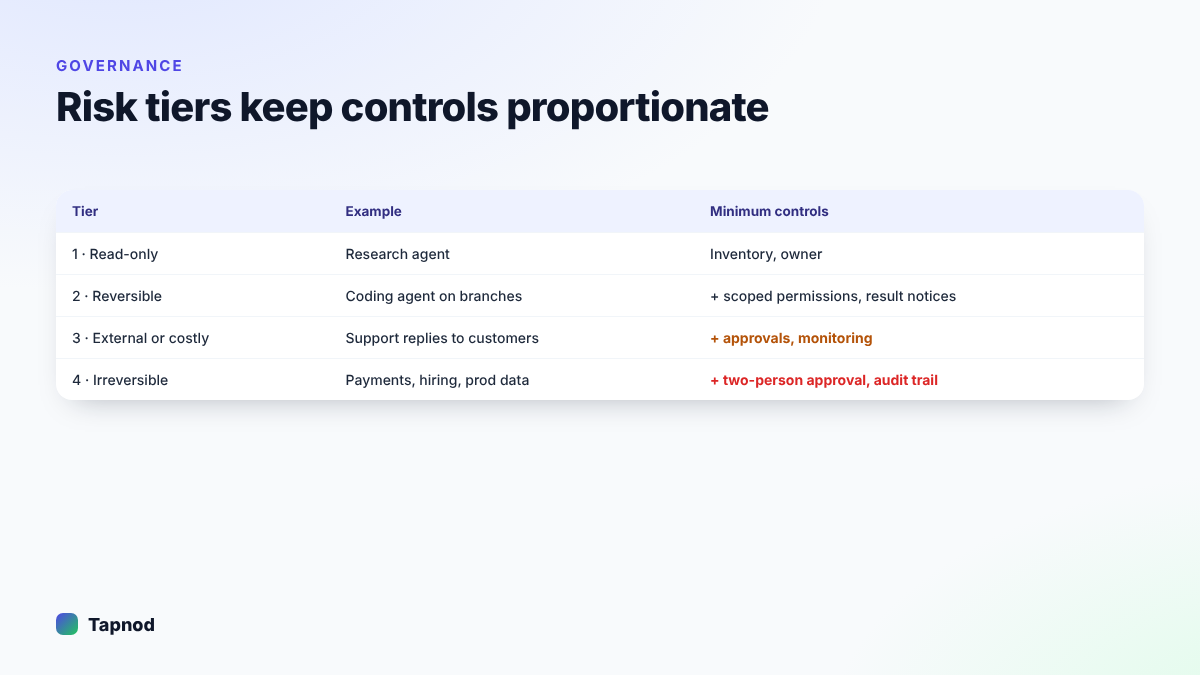
- Risk tiers: categories that set how much control each agent needs.
- Permissions: tools, data and actions allowed, asked or denied.
- Human oversight: approvals, questions and stop controls proportionate to risk.
- Records: an audit trail of actions and decisions.
- Review: a regular cadence to adjust all of the above.
The goal isn't paperwork. It's letting teams ship agents quickly without surprises.
"ai agent governance" gets about 590 US searches a month at a keyword difficulty of 45, with a cost per click around $27 (Semrush, November 2026). The high CPC signals buyers: governance is becoming a line item.
Why agents need their own governance
Traditional AI governance focused on models: training data, bias, accuracy. Agents add action. They use tools, hold credentials, talk to customers and change systems. Governance has to cover what an agent can do, not only what it says. And agents multiply quickly: developers start coding agents, teams add automation agents, vendors ship agents inside products. Without an inventory, nobody knows what's running.
1. Inventory
| Field | Example |
|---|---|
| Agent name | release-agent |
| Owner | platform team, M. Chen |
| Where it runs | CI runner, cloud |
| Framework / product | Claude Code in headless mode |
| Tools and data | GitHub, deploy API, staging DB |
| Credentials | Scoped deploy token, 30-day rotation |
| Risk tier | Tier 3 |
| Oversight | Approval for production deploys |
Start with a spreadsheet. The important part is that new agents get added before they run in production.
2. Ownership
Every agent has one accountable owner and a backup. The owner answers its questions, approves its risky actions or delegates that, reviews its errors, and retires it when it's no longer needed. Agents without owners are the ones that keep running long after anyone remembers why.
3. Risk tiers
| Tier | Description | Example | Minimum controls |
|---|---|---|---|
| 1 | Read-only, internal | Research agent summarizing docs | Inventory, owner |
| 2 | Writes reversible, internal changes | Coding agent on branches | + scoped permissions, result notices |
| 3 | External or costly actions | Support agent replying to customers | + approvals for defined actions, monitoring |
| 4 | Irreversible, regulated or high-impact | Payments, hiring decisions, production data | + two-person approvals, audit trail, legal review |
Tiers keep governance proportionate. A tier 1 agent shouldn't wait on the same process as a tier 4 one.
4. Permissions
Use allow, ask and deny at the tool level, scoped credentials, sandboxes and budgets. Review permissions when an agent gets a new tool or scope. See AI agent guardrails.
5. Human oversight
For each tier, define:
- Which actions need approval, and by whom.
- How requests reach people, and how fast they're expected to answer.
- What happens on timeout.
- How to pause or stop the agent.
See AI agent oversight for the see, steer and stop model.
6. Records
Keep an audit trail of runs, tool calls, human requests and decisions, linked by IDs and protected from edits. Tier 3 and 4 agents need longer retention. See AI agent audit trail.
7. Review
| Cadence | Review |
|---|---|
| Monthly | New agents, permission changes, approval patterns |
| Quarterly | Tier assignments, retired agents, incidents |
| Per incident | Root cause, control changes |
| On regulation changes | Mapping to legal requirements |
A policy in one page
AI Agent Policy (v1)
1. Every agent is registered in the inventory before production use.
2. Every agent has a named owner and backup.
3. Agents are assigned a risk tier (1-4) by the owner, reviewed by platform.
4. Tier 3+ agents require approvals for defined actions, routed to named roles.
5. Tier 4 agents require two-person approval for irreversible actions.
6. Credentials are scoped to the agent and rotated at least every 90 days.
7. All tier 2+ agents log actions and human decisions to the audit store.
8. Every agent can be paused or stopped by its owner and by platform.
9. Owners review their agents' approvals and errors monthly.
10. Unused agents are retired and their credentials revoked.
Governance and regulation
Regulation is catching up. The EU AI Act requires human oversight, records and risk management for high-risk uses, with those obligations now applying from December 2027 for most standalone high-risk systems. A governance framework built on inventory, tiers, oversight and records maps onto those requirements well. See EU AI Act human oversight.
Who runs governance
Governance works best with a small group that owns the framework, not every decision. Typically: someone from platform or engineering who owns tooling and defaults, someone from security who owns credentials and incidents, and someone from legal or compliance who maps rules to regulation. Agent owners make day-to-day calls within the framework. The group meets monthly, keeps the policy short, and changes it when practice shows a rule isn't working.
Making it lightweight
Governance fails when it's slower than building. Keep it light:
- Self-service registration with a short form.
- Default controls by tier, so teams don't design from scratch.
- Shared tooling for approvals, monitoring and logs.
- Fast exceptions: a named person who can approve an exception in a day.
Retiring agents
Governance includes endings. When an agent is no longer used, revoke its credentials, remove its permissions, archive its logs according to retention rules, and mark it retired in the inventory. Agents that are quietly abandoned keep their tokens, and old tokens are a common route for mistakes and attacks.
Metrics for governance
| Metric | Healthy sign |
|---|---|
| Agents in inventory vs discovered | Equal |
| Agents without owners | Zero |
| Median approval time for tier 3+ | Minutes |
| Credentials past rotation | Zero |
| Incidents with unclear accountability | Zero |
A worked example
Picture a 200-person software company. Developers use coding agents; support and finance run agents too. Governance starts with a two-week inventory that finds 34 agents, nine without clear owners. They assign owners, tier each agent and set default controls. Tier 3 agents route approvals to an inbox with phone notifications; tier 4 payments agents need two approvals. Monthly reviews take 30 minutes per team. Six months later, new agents go live in days, with fewer surprises than before.
Key takeaways
- Governance for agents covers actions, not only models.
- Start with an inventory and a named owner per agent.
- Use risk tiers so controls match impact.
- Combine permissions, human oversight and records, and review them on a schedule.
FAQ
What is AI agent governance?
The policies and practices that decide which agents may run, what they may do, who is accountable for them and how that's checked over time.
How is agent governance different from AI governance?
AI governance often focuses on models and their outputs. Agent governance adds tools, credentials, actions and human oversight of those actions.
Where should a team start?
With an inventory of every agent and a named owner for each, then risk tiers and default controls per tier.
Does governance slow down agent adoption?
Heavy governance does. Lightweight registration, default controls and shared tooling let teams ship faster with fewer incidents.
Where Tapnod fits
Tapnod supports the oversight part of governance: one inbox for agents' approvals and questions, with monitoring of last contact and waiting decisions. Try it free.