 Tapnod
The short answer
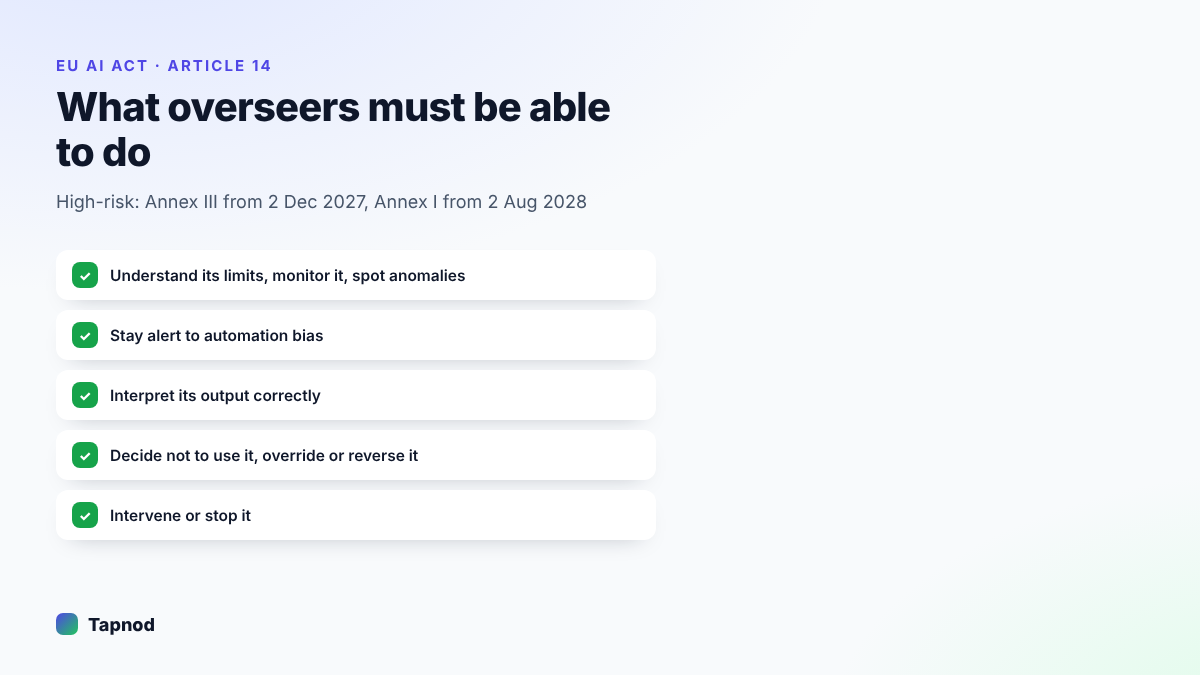
Article 14 of the EU AI Act requires high-risk AI systems to be designed so people can effectively oversee them while they're in use. The people overseeing a system must be able to understand what it can and can't do, watch for problems, stay alert to over-relying on it, interpret its output, decide not to use it or override it, and stop it.
The Act doesn't use the phrase "human in the loop" as a rule for every system. It sets oversight goals, and providers and deployers choose measures that fit the risk, which can mean a person approving each decision or a person supervising with the power to intervene.
Timing changed in 2026: the Digital Omnibus on AI moved the high-risk obligations to 2 December 2027 for standalone (Annex III) systems and 2 August 2028 for AI embedded in regulated products (Annex I).
This is general information, not legal advice. Check your situation with a qualified lawyer.
"eu ai act human in the loop" gets about 50 US searches a month at a keyword difficulty of 43 (Semrush, November 2026). Many searchers are product and compliance leads working out what the law expects from AI features they ship.
What Article 14 requires
High-risk systems must allow the people assigned to oversee them to:
| Capability | In plain terms |
|---|---|
| Understand capacities and limits | Know what the system is good and bad at |
| Monitor operation | Notice anomalies, malfunctions and unexpected behaviour |
| Stay aware of automation bias | Avoid trusting outputs because a machine produced them |
| Interpret output correctly | Have the tools and information to read results properly |
| Decide not to use, override or reverse | Overrule the system in a given case |
| Intervene or stop | Halt the system through a stop button or similar procedure |
For certain remote biometric identification systems, the Act goes further: a result must be separately verified by at least two people before action is taken.
Who has to do what
| Role | Main duties on oversight |
|---|---|
| Provider (builds the system) | Design oversight measures into the system, or specify them for the deployer, and explain them in the instructions for use |
| Deployer (uses the system) | Assign oversight to people with the competence, training and authority to do it, and follow the provider's instructions |
Deployer duties are in Article 26. Oversight isn't satisfied by naming someone; that person needs the skills, the time and the authority to act.
Does it apply to AI agents?
The AI Act regulates AI systems by their use, not by their architecture. An agent is high-risk if it's used in a high-risk area, such as those listed in Annex III: certain uses in employment, education, access to essential services like credit, law enforcement, migration, justice and critical infrastructure, among others.
| Agent use | Likely category |
|---|---|
| Coding agent refactoring your codebase | Not high-risk by itself |
| Support agent answering product questions | Usually not high-risk; transparency rules may apply |
| Agent screening job applicants | High-risk (employment) |
| Agent assessing creditworthiness | High-risk (essential services) |
| Agent managing parts of critical infrastructure | Potentially high-risk |
Even when an agent isn't high-risk, the oversight capabilities in Article 14 are good engineering practice, and customers increasingly ask for them.
The timeline after the Digital Omnibus
The original Act set 2 August 2026 for most high-risk obligations. The Digital Omnibus on AI, which entered into force in July 2026, pushed those back:
| Obligation | Date |
|---|---|
| Prohibited practices, AI literacy | Applied from 2 February 2025 |
| General-purpose AI model rules | Applied from 2 August 2025 |
| High-risk systems in Annex III (standalone) | 2 December 2027 |
| High-risk AI in products under Annex I | 2 August 2028 |
Commentators stress that the delay isn't a pause: transparency duties and other parts of the Act keep their own timelines, and the substance of the high-risk requirements, including human oversight, didn't change.
Mapping Article 14 to agent features
| Article 14 capability | Agent feature that supports it |
|---|---|
| Understand capacities and limits | Documentation of what each agent does, its tools and its known failure modes |
| Monitor operation | Live view of agents, last contact time, activity and errors |
| Automation bias awareness | Requests that show reasoning and uncertainty, not only a recommendation |
| Interpret output | Context with each decision: inputs, sources, confidence |
| Override or reverse | Reject and edit options on approvals; ability to undo actions |
| Intervene or stop | Pause, cancel and permission changes that take effect immediately |
| Records (with Article 12) | Logs of decisions, who made them and when |
In the loop or on the loop
Article 14 asks for oversight measures proportionate to the risks and the level of autonomy. For an agent ranking job applicants, that might mean a person reviews every rejection before it's sent (in the loop). For lower-impact steps inside a high-risk system, supervision with the power to intervene may be enough (on the loop). See human in the loop vs human on the loop.
Practical steps for teams
- Classify each agent use case against the Act's risk categories, with legal input.
- Name overseers with the training and authority to act, plus backups.
- Give overseers visibility: what each agent is doing, what it's waiting on, what failed.
- Build override and stop into every agent, and test them.
- Design requests to counter automation bias: show evidence, alternatives and uncertainty.
- Keep records of decisions and interventions, linked to runs.
- Train people in what the system can and can't do.
Automation bias in practice
Automation bias is the tendency to accept a machine's suggestion without enough scrutiny. Approval screens can make it worse: a big green "Approve" button and a confident summary invite a tap. Ways to counter it:
- Show the evidence behind a recommendation, not only the recommendation.
- Surface uncertainty and unusual features of the case.
- Occasionally ask reviewers to state a reason.
- Track how often reviewers overturn the system; near-zero rates deserve a look.
A worked example
Picture an HR tech company whose agent shortlists candidates. It's high-risk under Annex III. The provider documents the agent's limits and builds in a review step: no candidate is rejected without a recruiter's decision. Recruiters see the agent's reasons, the evidence from the application and a confidence note. They can override, and they can pause the agent for a role. Every decision is logged with the reviewer's name. The deployer trains recruiters on the agent's known weaknesses and assigns a backup for each role.
Key takeaways
- Article 14 requires high-risk AI to support effective human oversight.
- Overseers must understand, monitor, interpret, override and stop the system.
- High-risk obligations now apply from December 2027 (Annex III) and August 2028 (Annex I).
- Agents are high-risk based on their use, not because they're agents.
FAQ
Does the EU AI Act require human in the loop?
It requires effective human oversight for high-risk AI systems. That can be met with a person approving decisions or supervising with power to intervene, depending on risk and autonomy.
When do the human oversight rules apply?
For standalone high-risk systems in Annex III, from 2 December 2027; for high-risk AI in products under Annex I, from 2 August 2028, following the 2026 Digital Omnibus on AI.
Are AI coding agents high-risk under the AI Act?
Not by themselves. Risk depends on use; a coding agent working on your codebase isn't in an Annex III area.
What does a stop button mean for AI agents?
A reliable way for an overseer to halt the agent, such as pausing or cancelling a run, that takes effect right away.
Where Tapnod fits
Tapnod gives overseers a live view of agents, waiting decisions and results, with approve, comment and reply from any phone. Start free.