 Tapnod
The short answer
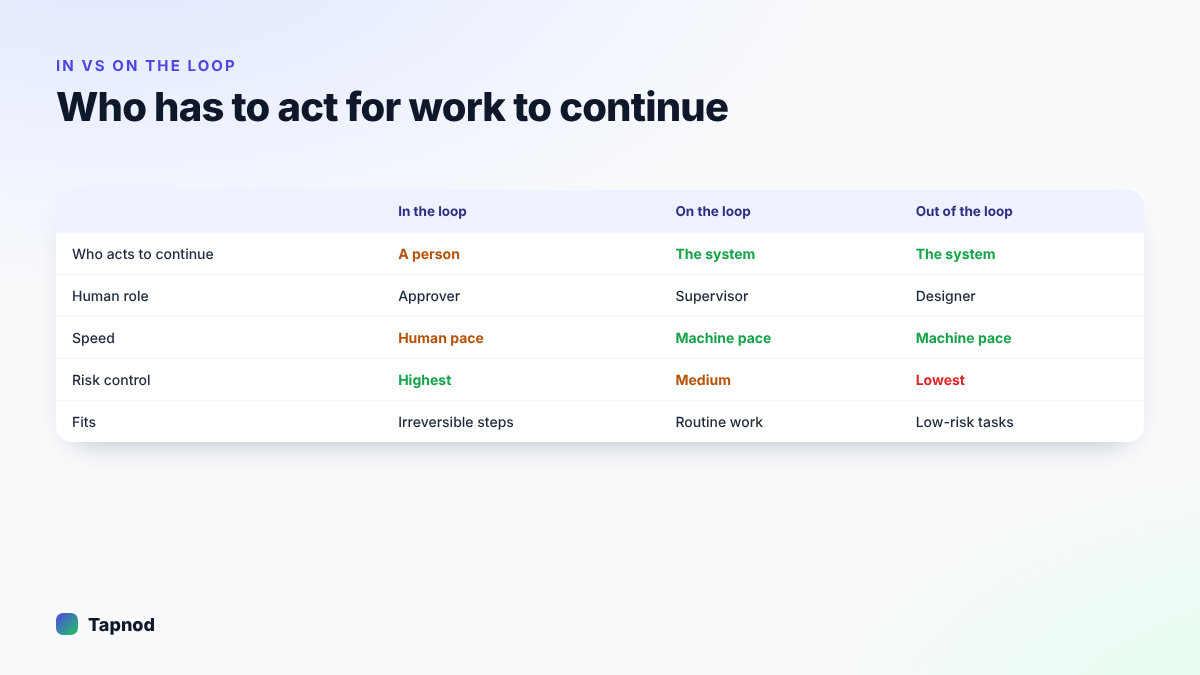
Human in the loop means the system can't continue a step until a person acts: it pauses and waits for approval or input. Human on the loop means the system keeps running on its own while a person supervises and can intervene or stop it. A third model, human out of the loop, runs with no human involvement during operation.
The difference is who has to act for work to continue. In the loop, the person does. On the loop, nobody does unless something looks wrong.
"human in the loop vs human on the loop" gets about 210 US searches a month at a keyword difficulty of 36, and the reverse phrasing gets another 210 (Semrush, November 2026). People searching this are usually designing a system and deciding how much control to keep.
Side by side
| Human in the loop | Human on the loop | Human out of the loop | |
|---|---|---|---|
| Who acts to continue | A person | The system | The system |
| Human role | Approver, decision maker | Supervisor, can intervene | Designer, reviewer after the fact |
| Speed | Limited by human response | Machine speed | Machine speed |
| Risk control | Highest | Medium | Lowest |
| Attention cost | High per decision | Spread across monitoring | Low |
| Typical use | Irreversible or high-stakes steps | Routine work with occasional risk | Low-risk, well-tested tasks |
Where the terms come from
Defense policy made the distinction famous. A human-in-the-loop weapon needs a person to authorize each engagement; a human-on-the-loop system can engage on its own while a person monitors and can abort; out-of-the-loop systems act without human supervision. AI and automation borrowed the vocabulary because the same question, how much does a machine decide alone, applies everywhere.
Examples in AI agents
| Agent task | Model | Why |
|---|---|---|
| Reading code, running tests | Out of the loop | No risk, no reason to interrupt |
| Editing files on a branch | On the loop | Reversible; review the PR later |
| Installing a new dependency | In the loop | Supply-chain risk |
| Running a production migration | In the loop | Hard to undo |
| Answering support tickets with a template | On the loop | Spot-check, intervene on complaints |
| Refunds above a threshold | In the loop | Money leaves the business |
Coding agents show both models in one session. Claude Code's permission rules can allow some commands to run freely (on the loop: you watch the session or its notifications) and set others to ask (in the loop: the agent stops until you answer).
What on the loop needs to work
On the loop sounds lighter, but it only works if supervision is real:
- Visibility: a live view of what each agent is doing and when it last checked in.
- Alerts: notifications on errors, unusual actions or silence.
- A stop button: a way to pause or kill a run quickly.
- Limits: budgets, rate limits and scopes that cap the damage before anyone notices.
Without these, "on the loop" quietly becomes "out of the loop". See AI agent monitoring.
What in the loop needs to work
- Good requests: a clear title, the proposed action, context and consequences.
- Fast reach: notifications where the person actually is, often a phone.
- Saved state: the agent can wait hours without losing work.
- Few, meaningful checkpoints: so approvals stay considered rather than automatic.
Questions to ask before choosing
Before you settle on a model for an action, answer these in writing:
- Who is the person in or on the loop, by name or role?
- How will they find out something needs them, and how fast?
- What can they see when they decide or intervene?
- What happens if they're asleep, on leave or ignoring notifications?
If you can't answer the second and fourth questions, the design isn't finished, whichever model you picked.
The failure modes
| Model | Common failure |
|---|---|
| In the loop | Approval fatigue: people approve without reading |
| In the loop | Bottlenecks: work waits on a busy reviewer |
| On the loop | Nobody is actually watching |
| On the loop | Alerts are too noisy to act on |
| Out of the loop | Small errors compound unnoticed |
The fix for most of these is the same: move each action to the model that matches its risk, and review the split regularly.
A framework for choosing
Ask four questions about each action:
- Can it be undone? If not, keep a human in the loop.
- Who sees a mistake? If customers or the public, lean in the loop.
- How often does it happen? Very frequent actions push toward on the loop, with limits.
- How good is the agent at it? A strong track record earns a move from in to on the loop.
Then revisit monthly. Actions that are always approved unchanged can move on the loop; actions that caused incidents move back in.
Moving an action between models
Actions shouldn't stay in one model forever. A sensible promotion path looks like this:
- Start in the loop. New agents and new actions ask every time.
- Measure. Track how often each action is approved unchanged, edited or rejected.
- Promote with limits. After a run of clean approvals, move the action on the loop with a cap, such as a maximum amount, a rate limit or a scope.
- Keep a tripwire. Any incident or unusual pattern moves it back in the loop automatically.
Demotion matters as much as promotion. If an on-the-loop action causes a problem, put it back behind an approval until you understand why.
Regulation and the terms
Laws rarely use these exact phrases, but they set expectations that map to them. The EU AI Act, for example, requires high-risk AI systems to be designed so people can oversee them, understand their outputs, override them and stop them. That can be met with in-the-loop or on-the-loop designs, depending on the risk. More in EU AI Act human oversight.
A worked example
Picture a team running a deployment agent. Building and testing is out of the loop. Deploying to staging is on the loop: it happens automatically, and the team gets a result card with a link. Deploying to production is in the loop: the agent sends a plan with the diff summary and waits. After three months of clean staging deploys, the team keeps production in the loop but adds a rule: hotfixes under 20 lines still ask, but with a one-tap approval and a shorter summary.
Key takeaways
- In the loop: a person must act before the system continues.
- On the loop: the system runs while a person supervises and can intervene.
- Match each action to its risk, reversibility and frequency.
- On the loop only works with real visibility, alerts and a stop button.
FAQ
What is the difference between human in the loop and human on the loop?
In the loop, the system waits for a person before continuing. On the loop, the system continues on its own while a person monitors and can step in.
Is human on the loop safe?
It can be, for reversible and routine actions, if supervision includes live visibility, alerts and a fast way to stop.
What is human out of the loop?
A system that runs without human involvement during operation. People design and review it, but don't take part in each run.
Which should AI agents use?
Both. Most teams put reads and drafts on or out of the loop, and keep irreversible or public actions in the loop.
Where Tapnod fits
Tapnod covers both models: approvals that keep you in the loop, and monitoring with last-contact times and results that keep you on it. Try it free.