 Tapnod
The short answer
Human in the loop AI is AI that depends on people at specific stages of its life: people label the data it learns from, rate its outputs during training, review its decisions when confidence is low, and approve its actions when it works as an agent. The point isn't to slow AI down; it's to put human judgment where the model is weakest or the stakes are highest.
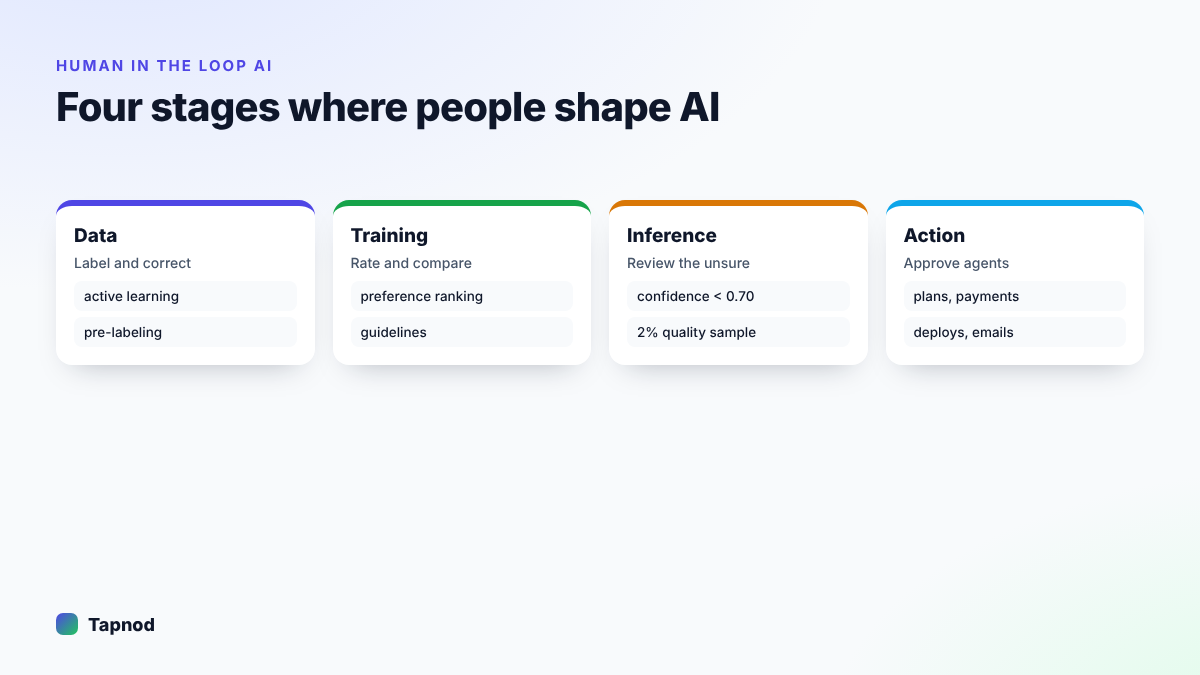
There are four stages where that happens: data, training, inference and action.
"human in the loop ai" gets about 880 US searches a month, at a keyword difficulty of 68 (Semrush, November 2026). A competitive term, because it sits at the center of how companies talk about responsible AI.
Stage 1: data
Models learn from examples, and many examples need people to label them. Human-in-the-loop labeling goes beyond one-off annotation:
- Active learning: the model picks the examples it's least sure about and sends those to people, so each label teaches it the most.
- Pre-labeling: the model suggests labels, and people correct them, which is faster than labeling from scratch.
- Quality review: a second person checks a sample of labels to catch drift and disagreement.
Stage 2: training
Large language models are shaped by human feedback after pre-training. People compare outputs and pick the better one, or rate responses against guidelines. That feedback trains a reward signal the model is tuned against. The quality of this stage depends on clear guidelines and reviewers who understand the domain.
Stage 3: inference
Once deployed, many AI systems send uncertain or high-impact cases to people:
| Signal | What happens |
|---|---|
| Low confidence score | Case goes to a review queue |
| High-impact decision | A person confirms before it takes effect |
| Policy match | Certain topics always get human review |
| Random sample | A small share is checked to measure quality |
A fraud model that's 99% sure lets a transaction through; at 70% it pauses for a person. The threshold is a business decision, balancing reviewer time against the cost of mistakes.
Stage 4: action
AI agents also act: they call tools, edit code, send messages and spend money. Human in the loop at this stage means approvals and questions:
- Plan approval before a long task starts.
- Action approval before risky tool calls.
- Questions when the agent lacks information.
- Error escalation when something fails.
- Result review when work is done.
This is the fastest-growing kind of HITL, and the hardest to get right, because agents run in many places and people need to answer from wherever they are. See human in the loop for agentic AI.
Routing by confidence in code
The inference stage often comes down to a few lines that decide who handles a case:
def route(case, prediction):
    if prediction.confidence >= 0.95 and case.amount < 1_000:
        return auto_approve(case, prediction)
    if case.amount >= 10_000 or case.flagged_by_policy:
        return send_to_review(case, prediction, queue="senior", reason="high impact")
    if prediction.confidence < 0.70:
        return send_to_review(case, prediction, queue="general", reason="low confidence")
    if random.random() < 0.02:
        return send_to_review(case, prediction, queue="qa", reason="quality sample")
    return auto_approve(case, prediction)
Two numbers, a confidence threshold and an amount threshold, decide most of your review volume. Change them deliberately and watch the overturn rate afterwards.
Design rules that apply at every stage
- Route by uncertainty and impact, not by habit. Review what the model gets wrong and what costs the most when wrong.
- Show the reviewer enough context to decide in seconds: the input, the model's output, why it was flagged.
- Make the human action structured: approve, reject, correct, with a reason. Structured answers become training data.
- Close the loop: feed corrections back into training or rules, or the same mistakes repeat.
- Measure the humans too: reviewer agreement, time to decision, and how often they overturn the model.
Metrics worth tracking
| Metric | What it tells you |
|---|---|
| Review rate | Share of cases sent to people |
| Overturn rate | How often people change the AI's decision |
| Time to decision | How long cases wait |
| Reviewer agreement | Whether guidelines are clear |
| Post-review error rate | Whether review actually catches mistakes |
An overturn rate near zero suggests you're reviewing too much. A high one suggests the model or its threshold needs work.
Who the humans are
The loop is only as good as the people in it. Labelers need clear guidelines and examples of hard cases. Reviewers at inference need domain knowledge and the authority to overturn the model. Approvers for agent actions need to own the outcome, so a refund approval goes to someone responsible for refunds, not whoever is online. Write down who sits at each stage, and give them a way to flag when the system asks too much or too little.
Common mistakes
- Reviewing everything. Reviewers burn out and start approving without reading.
- Hiding the reasoning. A bare "approve?" with no context leads to guesses.
- Ignoring feedback. Corrections that never reach the model waste reviewer time.
- No ownership. Queues without a named owner grow until someone notices a backlog.
- Treating HITL as permanent. Some checkpoints should be retired as the system proves itself.
Costs to plan for
Human review has a budget. Estimate it before launch: cases per day, times the review rate, times minutes per review. A model handling 5,000 cases a day with a 6% review rate and two minutes per review needs ten hours of reviewer time daily. If that's more than you have, raise the threshold, improve the model or narrow what gets reviewed.
Human in the loop AI and regulation
Regulators increasingly expect human oversight of high-impact AI. The EU AI Act requires high-risk systems to support effective human oversight, including the ability to understand outputs, override them and stop the system. Even outside regulated sectors, customers and auditors ask who checks the AI. A well-designed HITL process, with records of who decided what, answers that question. See AI agent audit trail.
A worked example
Picture an insurer using AI to triage claims. Labeling: adjusters correct the model's category suggestions on 200 claims a week, chosen by active learning. Inference: claims under $1,000 with high confidence are approved automatically; everything else goes to an adjuster with the model's reasoning attached. Action: an agent drafts customer letters, and any letter that denies a claim needs a person's approval. Each month, the team checks the overturn rate by claim type and adjusts thresholds.
Key takeaways
- Human in the loop AI uses people at the data, training, inference and action stages.
- Route work to people by uncertainty and impact.
- Structured human decisions should flow back into the system.
- Track overturn rate and time to decision to tune how much you review.
FAQ
What is human in the loop AI?
AI that relies on people at defined stages, such as labeling data, rating outputs, reviewing uncertain decisions or approving actions, so human judgment covers the cases the model handles worst.
What is an example of human in the loop machine learning?
Active learning, where the model asks people to label the examples it's least sure about, then retrains on those labels.
Is RLHF human in the loop?
Yes. Reinforcement learning from human feedback uses people's comparisons and ratings to shape a model's behaviour during training.
How is HITL different for AI agents?
Agents take actions, so the human role shifts from labeling and reviewing predictions to approving plans and actions, answering questions and handling errors.
Where Tapnod fits
For the action stage, Tapnod gives your agents one inbox for questions, plans, results and errors, with answers from your phone. Start free.