 Tapnod
The short answer
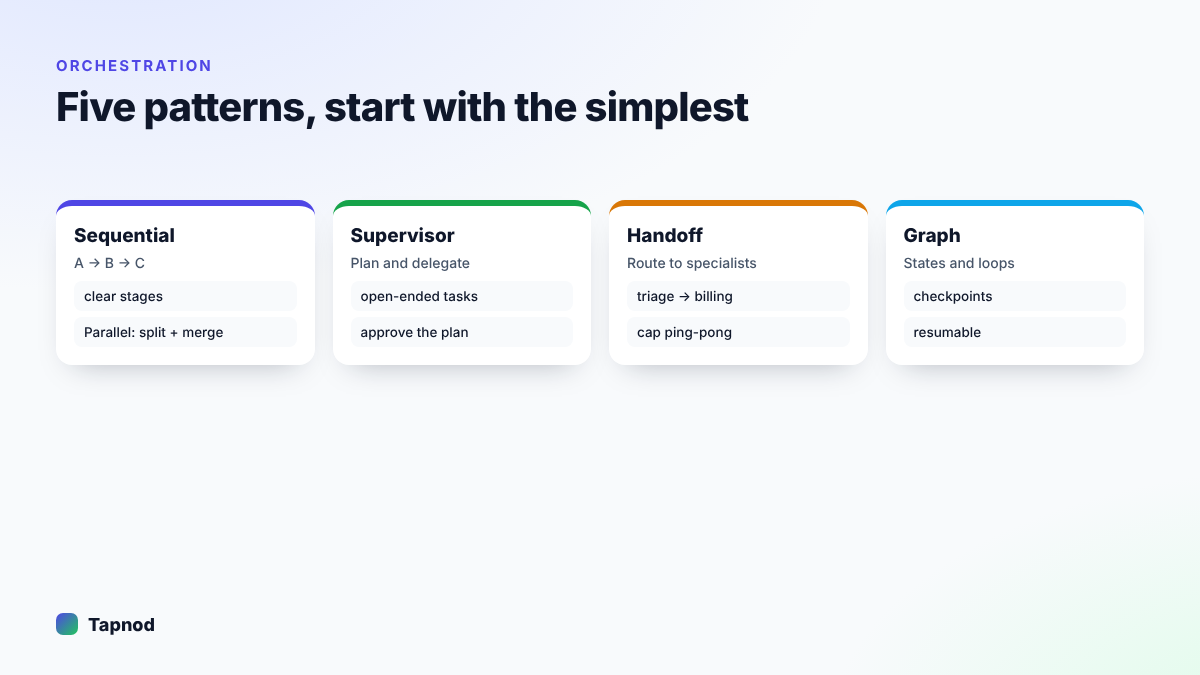
AI agent orchestration is how work is divided and coordinated among agents, tools and people to complete a task. Five patterns cover most systems:
| Pattern | Shape | Best for |
|---|---|---|
| Sequential | A → B → C | Pipelines with clear stages |
| Parallel | A, B, C at once, then merge | Independent subtasks |
| Supervisor | A manager agent assigns work to workers | Tasks that need planning and delegation |
| Handoff | Agents pass control based on the situation | Routing, like triage to specialists |
| Graph | Explicit states and transitions, with loops | Complex flows needing control and checkpoints |
The most common mistake is reaching for many agents too early. One agent with good tools beats five agents with vague roles.
"ai agent orchestration" gets about 1,000 US searches a month at a keyword difficulty of 45 (Semrush, November 2026), the largest multi-agent term in our research.
Sequential
How it works: each agent does one stage and passes its output on, like research → draft → edit.
Strengths: easy to understand, test and monitor. Each stage can have its own checks.
Weaknesses: slow, since stages wait for each other; errors early in the chain carry forward.
Parallel
How it works: independent subtasks run at once, then results are combined.
Strengths: fast for work that splits cleanly, like reviewing several files or researching several competitors.
Weaknesses: merging results takes care; subtasks that turn out to depend on each other cause conflicts.
Supervisor
How it works: a manager agent plans, assigns subtasks to worker agents and reviews their results.
Strengths: flexible for open-ended tasks.
Weaknesses: the supervisor is a single point of failure and a cost multiplier; vague delegation leads to wasted work.
Handoff
How it works: an agent hands the conversation or task to another agent better suited for it, as in the OpenAI Agents SDK's handoffs or AutoGen's swarm.
Strengths: natural for routing, such as support triage to billing or technical specialists.
Weaknesses: ping-pong between agents; context lost at handoff.
Graph
How it works: the flow is an explicit graph of nodes and edges, with conditions and loops, as in LangGraph or Microsoft Agent Framework workflows.
Strengths: control, checkpointing, resumability and clear places for human checkpoints.
Weaknesses: more design work upfront, and graphs can grow hard to read if every edge case becomes a new node.
Where people fit
Every pattern needs places where humans approve, answer or redirect:
| Pattern | Natural human checkpoint |
|---|---|
| Sequential | Between stages, before anything public |
| Parallel | At the merge, before acting on combined results |
| Supervisor | On the supervisor's plan |
| Handoff | When no agent can handle the request |
| Graph | Interrupt nodes before risky transitions |
Treat people as participants in the orchestration, with their own latency. See human in the loop for agentic AI.
Orchestration in code
# a minimal sequential pipeline with a human checkpoint
brief = planner.run(task)
sources = researcher.run(brief)
draft = writer.run(brief, sources)

decision = inbox.request(type="approval", title="Publish launch post?",
                         context=[f"{len(sources)} sources", f"{draft.word_count} words"],
                         options=["publish", "revise", "drop"])
if decision.choice == "publish":
    publisher.run(draft)
elif decision.choice == "revise":
    draft = writer.run(brief, sources, feedback=decision.comment)
Frameworks add state, retries and checkpointing, but the shape stays the same.
Passing context between agents
Most multi-agent failures happen at the seams. A handoff that passes the whole transcript bloats context and buries the point; a handoff that passes one line loses detail. Pass a structured brief instead:
{"goal": "Compare pricing pages of 3 competitors",
 "constraints": ["public pages only", "US pricing"],
 "done_when": "table with plan names, prices, limits",
 "known": ["Competitor B changed pricing in October"],
 "budget": {"steps": 25, "usd": 0.50}}
Goal, constraints, a definition of done, what's already known and a budget. Receiving agents perform better, and traces show exactly what each agent was asked to do.
Cost of orchestration
Every extra agent multiplies model calls. A supervisor that reviews each worker's output doubles the calls for that work; handoffs re-read context. Measure cost per successful task before and after adding agents. If a multi-agent version isn't clearly better on success rate, the single agent wins.
Frameworks by pattern
| Framework | Strong patterns |
|---|---|
| LangGraph | Graph, supervisor, any pattern with explicit state |
| OpenAI Agents SDK | Handoff, agents as tools |
| CrewAI | Sequential and hierarchical crews, Flows |
| Microsoft Agent Framework | Graph workflows, group chat, handoff |
| Google ADK | Sequential, parallel and loop agents, delegation |
Pitfalls
- Too many agents. Each one adds cost, latency and failure points. Start with one.
- Vague roles. "Researcher" and "analyst" that overlap produce duplicated work.
- Lost context at handoffs. Pass a structured brief, not a whole transcript.
- No end condition. Supervisors and handoffs can loop; cap turns and steps.
- No observability across agents. One trace per task, with handoffs visible. See agentic AI observability.
- Humans as an afterthought. Checkpoints designed late end up in the wrong places.
Testing orchestrated systems
Test each agent alone first, with fixed inputs, then test the seams: does the brief from agent A contain what agent B needs? Then test failure paths: a worker that times out, a handoff to an agent that can't help, a human who rejects the plan. Multi-agent systems usually fail at the seams and in the failure paths, not in the happy path.
Choosing a pattern
- Can one agent do it? Try that first.
- Are stages clear and ordered? Sequential.
- Do subtasks split cleanly? Add parallel.
- Is the task open-ended? Supervisor, with plan approval.
- Is it routing between specialists? Handoff.
- Do you need control, loops and resumability? Graph.
Orchestrating across tools, not only inside one framework
Real teams also orchestrate at a higher level: a coding agent in a terminal, a LangGraph service, an n8n workflow and a person all contribute to one outcome. No single framework coordinates them. What ties them together is shared visibility, a common place for questions and handoffs to people, and clear ownership. See AI agent orchestration platform.
A worked example
Picture a team building a competitor-analysis agent. Version one uses a supervisor with five workers and costs $4 per report with frequent loops. Version two uses a single agent with search and fetch tools, plus a parallel step that researches each competitor at once and a merge step. A person approves the final report before it's shared. Cost drops to $0.90, and failures become easy to trace.
Key takeaways
- Five patterns: sequential, parallel, supervisor, handoff and graph.
- Start with one agent; add orchestration only when the task needs it.
- Design human checkpoints into the pattern from the start.
- Cap loops, pass structured context and trace across agents.
FAQ
What is AI agent orchestration?
Coordinating multiple agents, tools and people to complete a task, through patterns like sequential pipelines, parallel work, supervisors, handoffs and graphs.
What is the best orchestration pattern?
The simplest one that fits. Sequential and parallel cover many tasks; supervisor and graph patterns suit open-ended or complex flows.
Do I need multiple agents?
Often not. One agent with good tools is cheaper and easier to debug. Split into multiple agents when roles, tools or permissions really differ.
How do humans fit into agent orchestration?
As checkpoints: approving plans, answering questions and reviewing outputs at points designed into the flow.
Where Tapnod fits
Tapnod is where the human side of orchestration lands: plans, questions, results and errors from every agent, answered from one inbox. Start free.