 Tapnod
The short answer
Human in the loop (HITL) means a system that does most of its work automatically but requires a person to take part at defined points, usually to approve, correct, label or decide. The person isn't watching from the side; the system can't finish certain steps without them.
The idea applies to very different systems: a machine learning model that learns from human labels, an automation that pauses for approval, a weapons system that needs a human to authorize force, and an AI agent that asks before deploying code. In each case, the loop is the cycle of the machine acting, a person responding and the machine continuing.
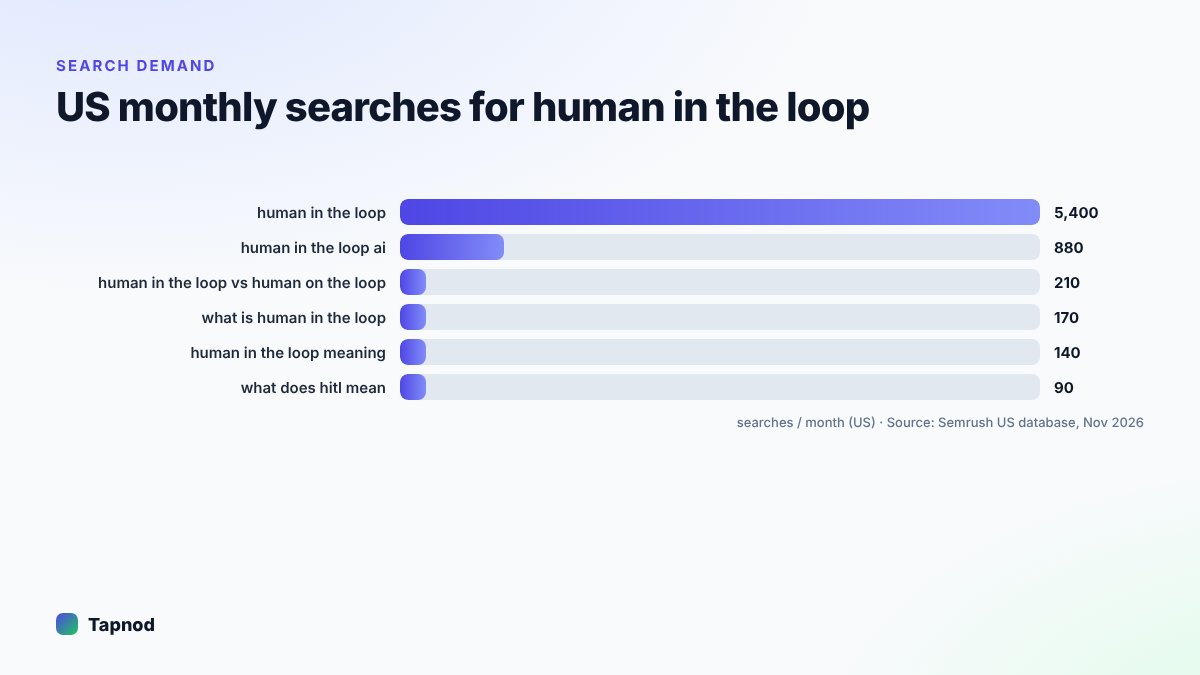
"human in the loop" gets about 5,400 US searches a month at a keyword difficulty of 42, and related questions add more: "what is human in the loop" (170), "human in the loop meaning" (140) and "what does hitl mean" (90) (Semrush, November 2026). The term has moved from research papers into everyday product language.
Where the term comes from
The phrase grew out of engineering and simulation, where "human-in-the-loop simulation" meant a model that included a real operator, such as a pilot in a flight simulator. Defense policy later used it to describe who authorizes force: a human in the loop must approve each action, while a human on the loop supervises and can step in. Machine learning borrowed it for systems that learn from human feedback. AI agents borrowed it again for approvals and questions during autonomous work.
The four common meanings
| Field | What the human does | Example |
|---|---|---|
| Machine learning | Labels data, corrects predictions | Reviewing uncertain images so the model learns |
| Model training | Rates outputs to shape behaviour | Ranking chatbot answers during fine-tuning |
| Business automation | Approves or edits before an action | Checking an AI-drafted email before it sends |
| AI agents | Answers questions, approves plans and risky actions | Approving a database migration an agent proposed |
The common thread is that human judgment is a required step, not an optional review after the fact.
Human in the loop vs on the loop vs out of the loop
| Model | Role of the person | When it fits |
|---|---|---|
| In the loop | Must act before the system continues | High-stakes or irreversible steps |
| On the loop | Monitors and can intervene | Routine work with occasional risk |
| Out of the loop | Not involved during operation | Low-risk, well-tested tasks |
Most real systems mix them: an agent runs on the loop for reading and drafting, and in the loop for sending, spending and deleting. More in human in the loop vs human on the loop.
How a HITL step works
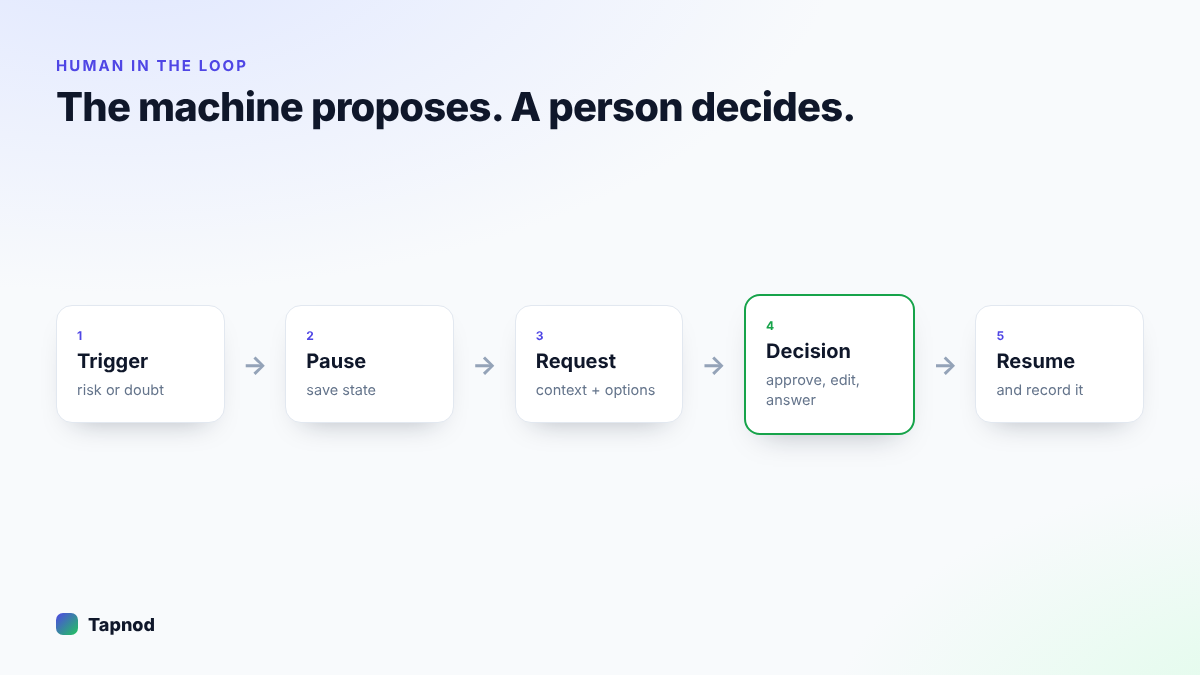
Whatever the field, a human-in-the-loop step has the same parts:
- A trigger: a rule that decides when a person is needed, such as low confidence, a risky action or a policy.
- A pause: the system stops that piece of work and saves its state.
- A request: the person sees what's proposed, the context and the options.
- A decision: approve, reject, edit, answer or escalate.
- A resume: the system continues with the decision.
- A record: who decided what, and when.
Skip any part and the loop breaks. A request without context gets rubber-stamped; a pause without saved state loses work; a decision without a record can't be audited.
What a HITL rule looks like
In practice, the trigger is often a small piece of configuration. Here is the kind of rule a team might write for an AI agent that handles billing tasks:
checkpoints:
  - action: issue_refund
    when: amount > 100
    ask: billing-lead
    options: [approve, reject, approve_partial]
    timeout: 4h
    on_timeout: reject
  - action: send_email
    when: recipient_domain != "ourcompany.com"
    ask: account-owner
    timeout: 2h
    on_timeout: hold
Each rule names the action, the condition, who decides, the choices and what happens on silence. That's the whole idea of human in the loop in a few lines: automation by default, a person where the rule says so.
Why keep a human in the loop
- Accuracy. People catch errors models miss, especially on unusual cases.
- Accountability. Someone owns the decision, which matters for customers, auditors and regulators.
- Safety. Irreversible actions get a second look.
- Learning. Human corrections become data that improves the system.
- Trust. Teams adopt automation faster when they know they can stop it.
The costs
HITL isn't free. Every pause costs a person's attention and adds delay. Too many approvals lead to approval fatigue, where people click yes without reading, which is worse than no review at all because it looks safe. Good HITL design asks for human input only where it changes outcomes.
Examples you've probably met
- Content moderation: models flag posts, people decide borderline cases.
- Fraud checks: unusual transactions pause until someone confirms.
- Medical imaging: software highlights regions, a radiologist makes the call.
- Coding agents: Claude Code or Codex asks before running a command outside its allowed list.
- Customer support: AI drafts replies, an agent approves or edits before sending.
Human in the loop for AI agents
AI agents raised the stakes, because they take actions, not only make predictions. An agent can open pull requests, send messages, change infrastructure or spend money. Human in the loop for agents usually means:
| Moment | Human role |
|---|---|
| Before starting | Approve the plan |
| During work | Answer questions the agent can't resolve |
| Before risky actions | Approve or reject the specific action |
| On failure | Decide whether to retry, change course or stop |
| On completion | Review the result |
The practical challenge is reach: agents run in terminals, servers and cloud sandboxes, while people are in meetings or on their phones. That's why agent HITL increasingly runs through inboxes and notifications rather than prompts in a terminal. See human in the loop for agentic AI.
Signs you need more human involvement
- Mistakes reach customers before anyone notices.
- Nobody can say who approved a past action.
- People don't trust the system enough to use it.
- Regulations in your sector require oversight.
Signs you have too much
- Approvals are almost always "yes", unchanged.
- Work waits hours for reviews that take seconds.
- Reviewers can't explain what they approved yesterday.
Key takeaways
- Human in the loop means a person is a required step in an automated process.
- It appears in machine learning, automation, defense and AI agents.
- Good HITL has a trigger, pause, request, decision, resume and record.
- Ask for human input only where it changes outcomes.
FAQ
What does HITL mean?
HITL stands for human in the loop: a system design where a person must take part at certain steps, such as approving, labeling or deciding, before the process continues.
What is an example of human in the loop?
An AI drafts a customer email, and a support agent reviews and approves it before it's sent.
Is human in the loop the same as human oversight?
They overlap. Human oversight is the broader goal of people being able to monitor and control a system; human in the loop is one way to achieve it, by making people a required step.
Does human in the loop slow things down?
It adds delay at the points where a person is needed. Well-placed checkpoints and mobile notifications keep that delay small.
Where Tapnod fits
Tapnod is a shared inbox where AI agents send questions, plans, results and errors, so the human step happens from your phone in seconds. Start free.