 Tapnod
The short answer
HumanLayer began as an API and SDK for human approvals in AI agents. Its @hl.require_approval() decorator paused a function until someone approved it in Slack or email, and hl.human_as_tool() let an agent ask a person a question like any other tool. The company later shifted to building an IDE and platform for orchestrating coding agents, going through a CodeLayer name in late 2025 before returning to the HumanLayer name. Reports and the project's own repository notes indicate the classic approval SDK is no longer the focus.
If you came for require_approval, the main alternatives are:
| Alternative | Replaces |
|---|---|
| Framework-native approvals | require_approval inside one framework |
| An agent inbox over MCP or webhooks | require_approval and human_as_tool across agents, with mobile answers |
| gotoHuman | Template-based reviews of AI outputs |
| Slack or email bots you build | HumanLayer's contact channels |
| Zapier or n8n human steps | Approvals inside automation workflows |
"humanlayer" gets about 720 US searches a month at a keyword difficulty of 53 (Semrush, November 2026). A good share of that traffic is developers who remember the SDK and want to know what to use now.
What the classic SDK did
from humanlayer import HumanLayer
hl = HumanLayer()

@hl.require_approval()
def send_email(to: str, subject: str, body: str):
    """Send an email to a customer."""
    ...

contact_a_human = hl.human_as_tool()  # give the agent a "ask a person" tool
Two ideas made it popular: approval enforced in code at the function level, and a human treated as a tool the agent can call. Both ideas are still right. The question is where to get them now.
What HumanLayer is now
Based on its public site and coverage through 2026, HumanLayer focuses on an IDE and cloud platform for running coding agents across a team, with human review built into a research, plan and implement workflow. That's useful if you want a structured environment for coding agents. It's a different product from an approval API for any agent.
Check HumanLayer's site for its current state; it has changed quickly.
Alternative 1: framework-native approvals
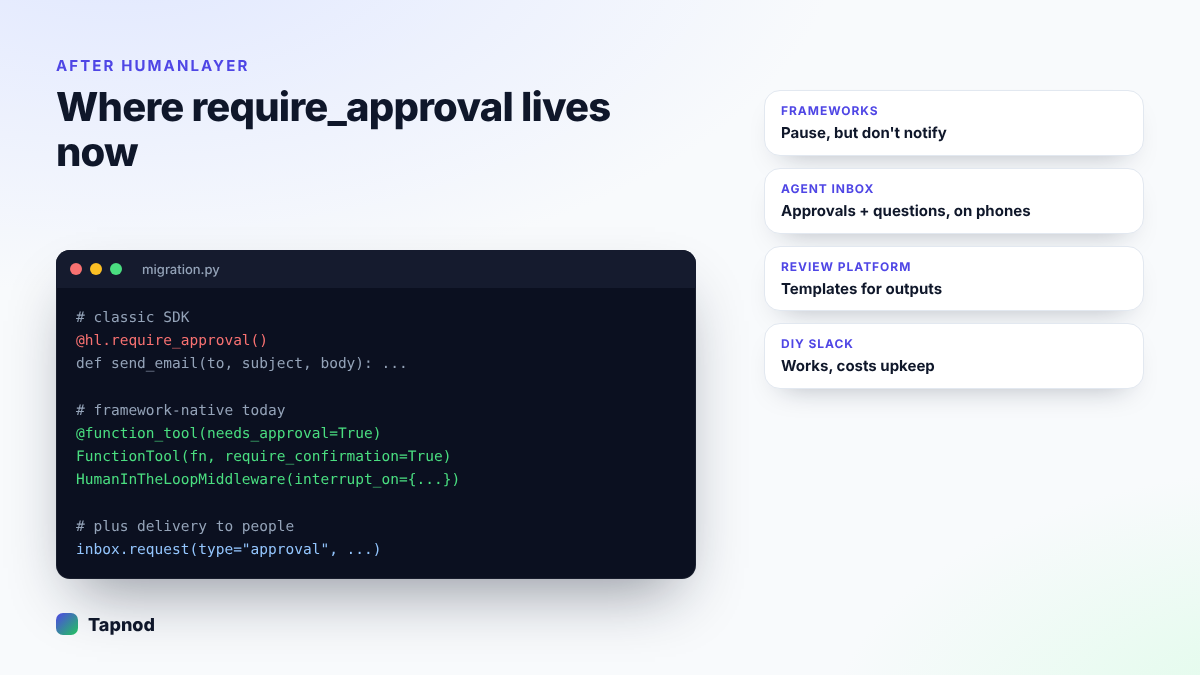
Every major framework now has the require_approval idea built in:
| Framework | Equivalent |
|---|---|
| OpenAI Agents SDK | needs_approval=True on a function tool |
| Google ADK | FunctionTool(fn, require_confirmation=True) |
| LangChain | HumanInTheLoopMiddleware(interrupt_on={...}) |
| LangGraph | interrupt() inside the tool |
| CrewAI | @human_feedback in Flows |
What you lose compared with HumanLayer: delivery. These pause the agent but don't notify anyone. You still need a way to reach people and send answers back.
Alternative 2: an agent inbox
An agent inbox covers both halves of what HumanLayer did: approvals and human-as-tool questions, delivered to people and returned to agents. Connection is usually MCP for agents that support it, plus webhooks or polling for everything else.
# a require_approval-style wrapper that sends requests to an inbox
def require_approval(fn):
    def wrapper(*args, **kwargs):
        req = inbox.request(type="approval", title=f"{fn.__name__}{kwargs}", options=["approve", "reject"])
        answer = inbox.wait(req.id, timeout=3600)  # or return pending and resume later
        if answer.choice != "approve":
            return f"Not run: {answer.comment or 'rejected'}"
        return fn(*args, **kwargs)
    return wrapper
For long waits, return a pending status and resume later instead of blocking, as described in human in the loop architecture.
Alternative 3: gotoHuman
A review platform with templates, an inbox, an SDK, an API and an MCP server. Good for structured reviews of AI-generated content. See gotoHuman alternatives for a fuller comparison.
Alternative 4: build Slack or email approvals
HumanLayer's contact channels were Slack and email. You can build a minimal version with a Slack bot that posts buttons and a webhook that receives clicks. It works for low volume; the costs show up later in maintenance, mobile experience and requests buried in channels.
Alternative 5: automation platforms
If your approvals happen inside workflows, Zapier's Human in the Loop and n8n's human review cover them without code. See human in the loop automation.
Lessons from the SDK era
HumanLayer's SDK got several things right that are worth keeping in whatever you choose:
- Enforce approval in code, not in the prompt. A decorator around the function can't be talked out of asking.
- Treat a person as a tool. Agents ask better questions when "ask a human" is a tool with a clear description.
- Route to channels people use. Approvals that sit in a dashboard nobody opens don't help.
- Keep the agent framework-agnostic. Approval logic at the tool-calling layer works with any model and framework.
The gap it left is mostly delivery and a home for answers across many agents. That's the part to evaluate most carefully in alternatives.
Migration checklist
- Find every
require_approvalandhuman_as_tooluse in your code. - Decide per agent: framework-native approval, or a wrapper that sends to an inbox.
- Recreate channels: where did approvals go before, and where should they go now?
- Add timeouts: decide what happens on no answer.
- Handle pending state: blocking calls are fine for short waits; save and resume for long ones.
- Test approve, reject, timeout and restart.
When HumanLayer's current product fits
If your main need is coordinating coding agents across a team, with human review of research and plans before implementation, HumanLayer's current IDE and platform may suit you directly. It's a different shape of tool from an approval API: you work inside it, rather than calling it from your own agents.
Comparison
| Framework-native | Agent inbox | gotoHuman | DIY Slack | |
|---|---|---|---|---|
| Approval in code | Yes | Yes, via wrapper or MCP | Yes, via SDK | Yes |
| Human as tool | Varies | Yes | Via input fields | You build it |
| Delivery to people | No | Yes, incl. mobile | Inbox | Slack |
| Across frameworks | No | Yes | Yes | Yes |
| Maintenance | Low | Low | Low | High |
A worked example
Picture a team with a LangChain agent that used @hl.require_approval() on send_invoice and human_as_tool() for questions to finance. They move approvals to HumanInTheLoopMiddleware and write a small worker that forwards each interrupt to their agent inbox, resuming the thread when finance answers. The "ask finance" tool becomes an MCP tool pointing at the same inbox. Finance gets one place to answer on their phones, and the code is simpler than before.
Key takeaways
- HumanLayer's classic approval SDK is no longer the company's focus.
- Frameworks now have
require_approval-style features built in, but not delivery. - Agent inboxes replace both approvals and human-as-tool across frameworks.
- Migrate by mapping each decorator to a framework feature or an inbox wrapper.
FAQ
What happened to HumanLayer?
The company moved its focus to an IDE and platform for orchestrating coding agents. Reports and its repository notes indicate the original approval SDK is no longer the main product.
What replaces require_approval?
Framework features like needs_approval or require_confirmation, or a wrapper that sends approval requests to an inbox and resumes on the answer.
What replaces human_as_tool?
An "ask a human" tool, often exposed over MCP, that sends the question to an inbox and returns the person's answer.
Can I still use the old HumanLayer SDK?
Check its repository and site for current status before relying on it in production.
Where Tapnod fits
Tapnod covers the HumanLayer use case for many agents: approvals and questions over MCP, webhooks or polling, answered from your phone. Start free.